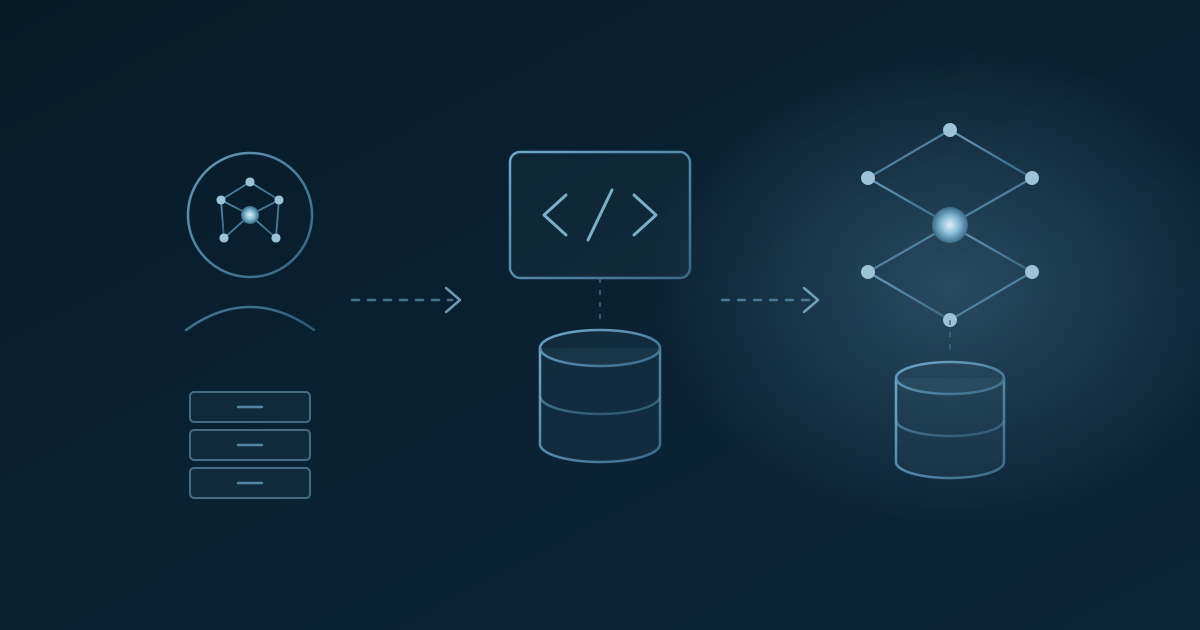
Key takeaways
- Business logic has had three homes: the human brain, then software, and now artificial brains. Each move changed who — or what — does the thinking.
- Every era kept one constant: the business still had to remember. Paper files became databases; databases are becoming governed memory.
- SaaS built its value by freezing business logic into code. An AI that can reason threatens that layer directly — but systems of record endure.
- The blocker is determinism. We made humans reliable through training, procedure, and supervision. AI needs the same treatment — and that's where the next decade will be won.
Era one: when the brain was the computer
Picture a trading office a century ago. The mail arrives by courier. A clerk opens the envelope, reads the letter, understands what's being asked, walks to the cabinet, pulls the customer's file, checks the ledger, applies the firm's rules, makes a decision, writes a reply, and files the paperwork before the next envelope lands.
Look at that sequence with modern eyes and you'll recognise every layer of an enterprise system. The letter is the API request. Reading it is parsing. The rules are business logic. The cabinet is the database. The reply is the response payload. Except none of it ran on silicon — all of it ran in a human brain, with paper as the only storage layer.
And here's the part we forget: companies knew how to program those brains. Apprenticeships, procedure manuals, double-entry checks, supervision. A well-trained clerk was remarkably deterministic — same invoice, same rules, same outcome, every time. That reliability was engineered, not innate. It just didn't scale: the machine went home at six, took its training with it when it resigned, and could only process one envelope at a time.
Era two: the great compilation
Then we learned to compile. Everything about the clerk's job that could be written as a rule was translated into code, and everything in the cabinet was translated into a database. The repeatable half of human thinking moved out of the skull and into the machine — and the machine didn't go home at six.
This is what the entire software industry actually is. Every SaaS product you've ever bought is a piece of manual work that someone studied, understood, and froze into deterministic code. Software engineers became the translators of the era: they observed how the business thought, wrote it down in a language a computer could execute, tested it, and shipped it. The computer became the brain, the execution engine, and the filing cabinet, all at once.
But only partially the brain. Humans stayed in the loop for everything that wouldn't compile: judgement, exceptions, ambiguity, the customer whose situation fits no rule. Software of this era is perfectly reliable and perfectly literal — it does exactly what it's told, and only what it's told. The moment reality steps outside the spec, a human picks up the case.
Software ate the world by making business logic deterministic. AI eats software the day it learns the same trick.
Era three: the return of the brain
Now something genuinely strange has happened. We've built an artificial brain that works the way the era-one clerk did. A large language model can read the email, understand what's being asked, reason about the edge case, weigh the rules, and decide — not because someone pre-wrote a branch for that exact situation, but because it can actually think through the problem. Execution is moving back into a brain. It's just not a human one this time, and unlike the clerk, it can read a million envelopes at once.
The recursion goes further: this new brain also writes code. The defining labour of era two — engineers translating business thinking into software — is itself being absorbed by the thing era two was built to serve. The translator is being translated.
What's exposed, and what endures
Follow the logic and the industry map redraws itself. If an artificial brain can execute a workflow by reasoning about it directly, then a product whose entire value is that same workflow pre-compiled into screens and buttons has a problem. That's a large share of SaaS. The logic layer — the expensive, defensible thing for twenty years — is commoditising.
What endures is the other half of every era: the part that remembers. No era, however clever its brain, escaped the need for storage. The clerk needed the cabinet; the software needed the database; the model needs a trusted record of the business — who the customers are, what was decided, what happened last time, and why. That record has gravity. It's where compliance lives, where trust lives, where the company's actual identity lives. Systems of record will outlast systems of workflow, and they will still need humans to own, govern, and manage them.
The determinism problem
There is one honest catch in this story, and it's the most important paragraph in it. The era-one brain was made reliable by a whole apparatus we've stopped noticing: training that instilled the rules, procedures that constrained the work, supervisors who checked it, audits that caught the drift. Determinism in humans was never natural — it was manufactured.
The artificial brain hasn't had that treatment yet. An LLM can reason brilliantly and still give you two different answers to the same question on two different days. For a demo, that's charming. For a business — payroll, compliance, a customer's money — it's disqualifying. Raw intelligence was never the thing enterprises paid for. Repeatable intelligence was.
So the frontier of this era isn't building a smarter brain. It's rebuilding, for artificial minds, the apparatus that once made human minds dependable: persistent memory in place of training, guardrails in place of procedure, human control in place of supervision, and an auditable record of every decision in place of the paper trail. Whoever industrialises that turns AI from an impressive demo into a workforce — and then, just as era two absorbed the clerical work, era three will absorb a very large share of the thinking work.
The through-line
Three eras, one pattern. Execution has always migrated to the cheapest reliable brain available — human, silicon, and now synthetic. Memory has never migrated at all: it has only changed form, from cabinet to database to governed organizational memory, and it has always belonged to whoever was wise enough to keep it. The companies that thrive in era three won't be the ones with the smartest models — everyone will have those. They'll be the ones whose memory is deep enough to make an artificial brain behave like their best employee, and governed enough to prove it.
Common questions
What is business logic?
The rules and judgements a company applies to turn information into action: read the request, check the records, apply the policy, make the call, act. Every business runs on it — whether it executes in a clerk's head, a software system, or an AI model.
Why is SaaS at risk in the AI era?
Most SaaS is business logic frozen into code — a manual workflow translated into deterministic software. When an AI brain can read a request, reason about it, and execute the workflow directly, the value of pre-compiled logic shrinks. Products whose only moat is encoded workflow are exposed; products that hold the system of record are far more durable.
Why will storage and systems of record survive?
Every era changed where logic executes; none removed the need to remember. Paper files became databases; databases become governed memory. Even a perfect artificial brain needs a trusted, auditable record of the business — and that record still needs owning, securing, and managing.
What is the determinism problem with AI?
LLMs can reason, but the same input can produce different outputs. Businesses need repeatable outcomes. Humans were made reliable through training, procedure, supervision, and audit; AI needs the same apparatus — persistent memory, guardrails, human control, and auditable records of what was done and why.
Give the artificial brain a memory — and a supervisor
EdgeX11 is built for era three: AI execution under human control, running on an organizational memory your company owns. The brain is new. The apparatus that makes it dependable is ours.
Talk to us