Key takeaways
- Assistants and employees run on the same frontier intelligence — the difference is responsibility, not IQ.
- An assistant amplifies a person who is present. An employee owns an outcome when nobody is watching.
- An AI employee doesn't replace your coding agents — it works with the same class of tools, in a sandbox, on your behalf.
- Ownership without governance is a liability, so governance is built in: least privilege, approval gates, a full audit trail.
- Assistant sessions end and their context evaporates. An employee writes what it learned into the organizational memory.
- Over MCP, the tools your team already uses — Claude Code, Cursor, Codex, Antigravity — feed that same memory.
- Compounding is a property of the organization's memory, not of any single model or session.
Let's be honest about the assistants first
Claude Code, Cursor, Codex, Antigravity — these are some of the best tools ever put in front of software engineers. We use them daily ourselves, and this site was largely built with them. When you're in the editor with one of them, the loop is seconds long: you ask, it drafts, you judge, you steer. Work that took an afternoon takes twenty minutes.
So no — an AI employee is not a claim that we've built something smarter than your assistant. It runs on the same class of frontier intelligence. If you're comparing IQ, the comparison is boring: it's a tie, by construction.
What's different is the job description.
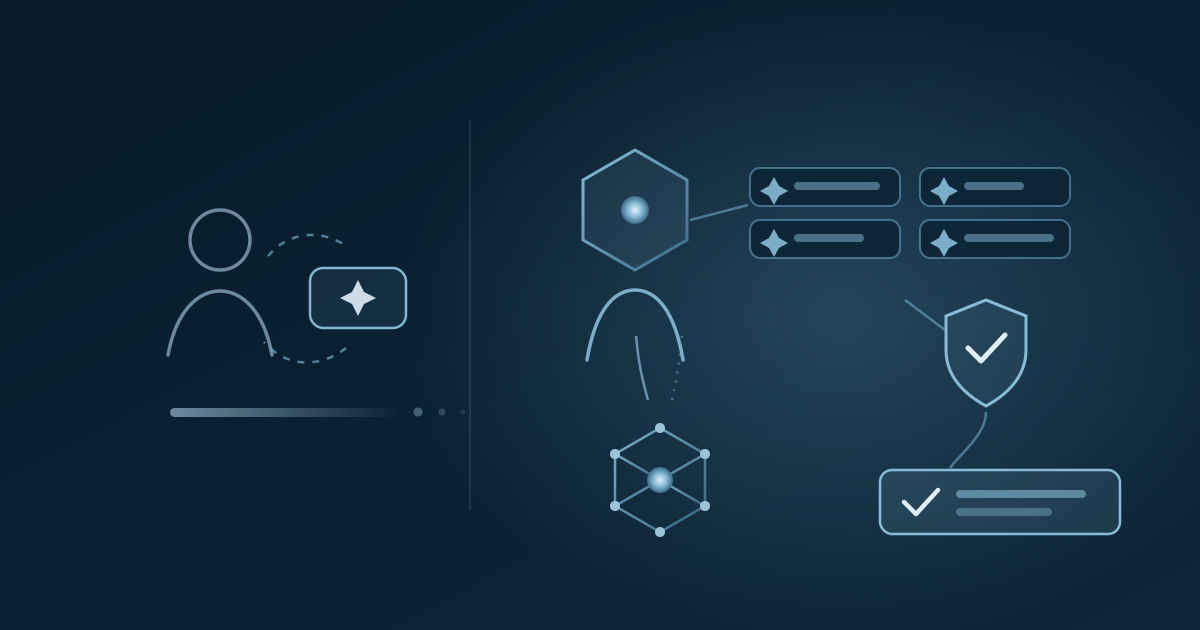
An assistant amplifies. An employee owns.
Every assistant, however capable, has one silent assumption built into its interface: you are there. You're the one holding it. You supply the context at the start of the session, you review each step as it happens, and you carry the outcome — because the assistant's responsibility ends when your session does.
That's not a flaw. It's the correct design for the job of amplifying a person who is present.
But most of the work in an organization isn't shaped like that. A ticket needs investigating, fixing, testing and shipping — while you're in a meeting. An incident needs owning at 2:47 AM — while you're asleep. This morning's post needs writing from what shipped yesterday — while you're building today's thing. Nobody is "present" for this work. Somebody just has to own it.
That's the whole distinction. An assistant makes the person holding it more capable. An employee is accountable for an outcome when nobody is holding anything.
An AI employee doesn't compete with your coding tools. It shows up to work carrying them.
The employee's toolbox looks familiar
Here's the part that surprises people: when an EdgeX11 employee does engineering work, what it does in its sandbox looks a lot like what your engineers do at their desks — it reads the code, forms a plan, writes changes, runs the tests, iterates. The same class of agentic coding intelligence your team uses by hand, the employee uses on your behalf, inside a scoped environment.
So the relationship between your assistants and your employees isn't rivalry. It's closer to the relationship between a great engineer and their tools. The intelligence in the tools is a given — everyone has access to it now. The questions that actually differentiate outcomes are the ones intelligence alone doesn't answer: who holds the context, who carries the accountability, and where does what was learned go afterwards?
Ownership requires governance
The moment something owns work instead of assisting with it, a new requirement appears that assistants never had to meet: governance.
An assistant doesn't need approval gates, because you're approving every step by reading it. An employee does, because you're not there. So at EdgeX11 the governance isn't a setting you remember to switch on — it's the shape of the product:
- Least privilege. An employee reaches only the systems its role needs. Nothing else exists to it.
- Approval gates on the sharp edges. Production deployments, security-sensitive changes, infrastructure changes and customer-facing messages stop and wait for a person. The employee prepares the change and asks; a human decides.
- Everything on the record. Every action, every approval, every refusal is logged and attributable. "Why did it do that?" is always an answerable question — with the diff, the reasoning and the approver captured together.
Autonomy is earned, recorded, and revocable
Because every employee accumulates a visible track record, trust can widen for a documented reason instead of on faith — the way a strong hire earns it. And a kill switch stops every automated action at once, always.
This is why "employee" is the responsible word, not the grandiose one. Calling something an employee means accepting that it needs what employees need: defined access, a manager's sign-off on consequential decisions, and a record of its work.
The memory is where it stops being a session
Now the part that actually compounds.
When an assistant session ends, its hard-won context — the codebase understanding, the decision you talked through, the gotcha you hit at minute forty — evaporates. Tomorrow's session starts from zero. Multiply that by every engineer, every tool, every day, and you're paying an enormous recurring tax measured in re-explained context.
EdgeX11's answer runs in both directions:
In: over MCP, the tools your team already uses — Claude Code, Cursor, Codex, Antigravity — push the context they build into one organizational memory as your team works. The decision made in a Cursor session on Tuesday is there for whoever, or whatever, needs it on Friday. Your team's own work flows in the same way, through the tools they already use.
Out and back: every AI employee works from that memory and writes back to it. When Nightwatch handles an incident, it recalls the OOMKill from three months ago in seconds — and tonight's five-whys becomes part of the memory too. When EngageX writes the morning post, it writes from what actually shipped — because what shipped is in the memory. Every finished task makes the next one start further ahead.
The knowledge belongs to the organization — not to a single tool, a single session, or a single person's head.
Knowledge that learns. Work that compounds.
Our baseline sentence is a mechanism, not a slogan, and this is the mechanism.
Knowledge that learns: the memory isn't a wiki someone maintains. It connects and enriches itself as work flows through your tools — every fix linked to its incident, every decision linked to the code it shaped.
Work that compounds: a day-100 employee outperforms its day-1 self with the same model underneath, because the memory grew. A new engineer inherits years of context on day one. Your assistants get sharper too, because the context they're handed comes from the same shared memory they help fill.
Intelligence is now the commodity everyone has. The assistants put it in every engineer's hands, and they're brilliant at it. What compounds is what your organization keeps — and employees, governance and memory are how you keep it.
Common questions
Is an AI employee smarter than Claude Code or Cursor?
No, and that's the point. They draw on the same class of frontier models. The employee differs in what it's responsible for: it owns a task end to end, works inside governance, and pays what it learns into your organizational memory instead of losing it when the session ends.
Do we have to stop using our coding assistants?
The opposite. Your team keeps using Claude Code, Cursor, Codex and Antigravity — and over MCP those tools push the context they build into the same organizational memory your AI employees work from. The assistants make the memory richer; the memory makes everything sharper.
What stops an AI employee from doing something dangerous?
Governance that's built in, not bolted on: least-privilege access scoped to its role, explicit human approval for production deployments, security-sensitive changes, infrastructure changes and customer-facing messages, and an audit trail of every action, approval and refusal.
How does an employee actually get better over time?
Not by changing the model. Every finished task — the decision, the fix, the outcome — lands in the organizational memory, so the next task starts with more context. A day-100 employee outperforms its day-1 self because the memory grew, and that improvement belongs to your organization.
Where does the work actually happen?
In sandboxed environments with scoped access. The employee investigates, writes and tests there, using the same kinds of agentic tools your engineers use, and brings the result — a tested PR, a drafted post, an incident RCA — to a human for anything that crosses a governance line.
What does “Knowledge that learns. Work that compounds.” mean in practice?
That the asset you accumulate is the memory, not the transcript. Knowledge that learns: the memory connects and enriches itself as work happens. Work that compounds: every employee, every tool and every teammate starts from everything the organization has already figured out.
Hire an employee. Keep your assistants.
Connect the tools you already use, assign one real task, and watch what it learned land in your organizational memory. Nothing ships without your approval.
Start free