Key takeaways
- GTM engineering builds the pipeline; on its own, the pipeline learns nothing durable. Execution and memory are different layers.
- GTM learning is relational — this message worked for that segment because of this signal — which is why it belongs in a knowledge graph, not in CRM custom fields.
- A CRM is a system of record for deals. Nobody runs a system of record for learnings — the decisions, experiments and reasons. That's the missing SoR.
- LLMs make the graph usable: they capture learning from work as it happens, and answer questions over it with provenance instead of vibes.
- The operating model is AI employees and humans on the same memory: AI runs the machinery and writes everything down; humans steer, approve and correct — and the corrections persist.
- Large organizations don't have a GTM talent problem; they have a GTM forgetting problem. Scale multiplies it, and shared governed memory is the fix.
The pipeline was the easy half
In the previous piece we described GTM engineering: the discipline of treating distribution as a production system — signal, enrich, score, route, reach, measure, loop. That pipeline is real, it works, and by now it's also table stakes. The tooling is commodity. A competitor can stand up the same stack in a fortnight.
Which raises the uncomfortable question: if everyone has the pipeline, where does the advantage live? It can't be in the machinery. It has to be in what the machinery knows — and that's precisely the part nobody engineered. Ask a revenue team what their forty experiments taught them last year and you get a shrug, a spreadsheet tab, and a Slack thread someone half-remembers. The pipeline executed; the organization learned almost nothing it can retrieve.
The pipeline is table stakes. The memory is the moat.
Why GTM learning refuses to fit in rows
Teams have tried to store this knowledge before — in CRM custom fields, in wiki pages, in "win/loss" decks. It never sticks, and the reason is structural: GTM learning is not a list of facts. It's a web of relationships.
A real learning looks like this: the compliance-angle message outperformed the cost-angle message, but only for mid-market banks, only when the signal was a new hire in risk, and the play was killed in March because replies collapsed after the segment saturated. That single sentence connects a message, two segments, a signal, an experiment, an outcome, a decision and a reason. Flatten it into a row and the connections — which are the entire value — disappear. Six months later the row says "killed" and nobody knows why, so someone re-runs the play.
There is a data structure built for exactly this: a knowledge graph. Accounts, people, segments, signals, plays, messages, experiments, outcomes and decisions as nodes; worked-for, failed-for, was-killed-because, predicted, replaced as edges. The graph doesn't summarise the learning — it is the learning, in queryable form. "Show me every play we've ever run against mid-market banks, what happened, and why we stopped" becomes a traversal, not an archaeology project.
This is also, not coincidentally, the shape modern AI needs. An LLM with a flat document dump retrieves plausible-sounding fragments. An LLM over a knowledge graph retrieves connected context — and can cite the path it walked to get there. The graph is what turns "applied AI" from autocomplete into institutional judgment. It's why we built our own graph database rather than bolting memory onto a vector store.
The system of record nobody runs
Enterprises are disciplined about systems of record. Finance has the ledger. HR has the HRIS. Sales has the CRM. Each one is authoritative, governed, auditable: there is one truth, you know who changed it, and it survives any individual leaving.
Now notice what has no system of record anywhere in the building: what the company has learned. The CRM records that the deal closed lost; the reasoning lives in the rep's head. The experiment log — if it exists — is a spreadsheet owned by someone who left in June. The decision to abandon a segment two years ago is a decision nobody can explain. The most valuable asset a go-to-market organization produces is treated as exhaust.
So the second layer on top of the graph is system-of-record management — the boring, load-bearing governance that makes memory trustworthy enough to act on:
- One authoritative store. The graph is where learnings live — not one copy per region, per team, per tool.
- Provenance on every claim. Each edge knows where it came from: which experiment, which thread, which human decision. When the AI answers, it cites.
- Versioned, not overwritten. Markets change. "This messaging works" is a claim with a date, superseded — never silently deleted — when evidence changes.
- Permissioned and auditable. Who can read competitive intel, who can amend a decision record, and a trail of who did. The same properties that make the compliance question answerable.
A knowledge graph without governance is a wiki with better topology — it decays the same way. Governance without the graph is bureaucracy around knowledge nobody can query. You need both, and they're worth naming as one thing: the GTM system of record.
Three layers, one system
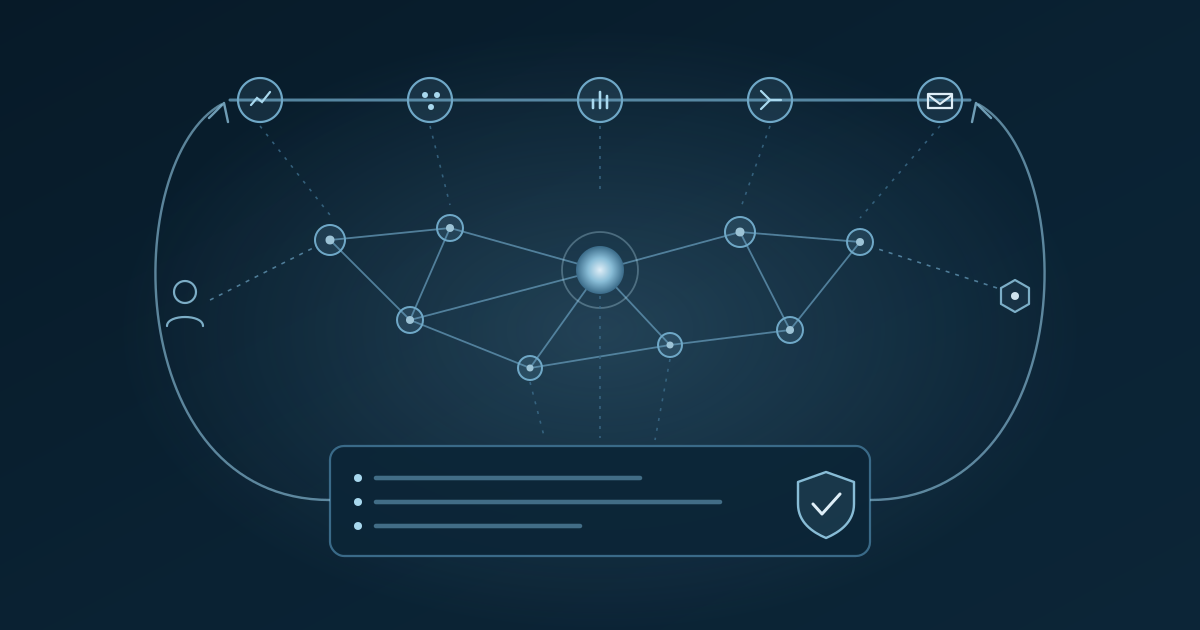
Execution — the GTM engineering pipeline: signal, enrich, score, route, reach. Memory — the knowledge graph: every play, outcome and reason, connected and queryable. Governance — system-of-record discipline: provenance, versioning, permissions, audit. The pipeline acts, the graph remembers, the governance makes the memory something a large organization can actually trust. Applied AI is the connective tissue between all three.
Humans and AI employees, on the same memory
Here is where this stops being architecture and becomes an operating model. The reason GTM memory has never been captured is honest economics: writing down every experiment, outcome and rationale is a full-time documentation job nobody was ever going to fund. Humans are for judgment, not bookkeeping.
LLMs changed that economics. Capturing structured learning from unstructured work — an email thread, a call summary, an experiment result — is exactly what they're good at. So the division of labour becomes clean:
- AI employees run the machinery and keep the record. They watch signals, enrich and score accounts, draft outreach from what the graph already knows, and — crucially — log every experiment, outcome and decision into the graph as a side effect of doing the work. Documentation stops being a chore because nobody is doing it as a chore.
- Humans steer and correct. Strategy, positioning, approval of what goes out — and corrections. When a human says "never lead with price for this segment, they buy on risk," that's not feedback lost in a chat window. It becomes an edge in the graph, with the human's name on it.
- Both read from the same truth. A new rep's first week and an AI employee's next task start from the same place: the accumulated, governed record of everything the organization has learned. Nothing starts from zero, and nothing is paid for twice.
This is the difference between "we added AI to our GTM stack" and a genuine human-AI team. Tools forget when the session ends. Employees — human or AI — accumulate. The memory is what makes the second thing possible.
Why this is the answer for big organizations
Everything above matters for a startup. For a large enterprise it's existential, because scale multiplies forgetting:
- Fragmentation. Twelve product lines, six regions, four generations of martech. Each pocket learns locally; nothing propagates. The EMEA team spends a quarter discovering what the US team killed last year.
- Churn. A fifth of the revenue organization turns over annually, and their context walks out the door — precisely the context that made them effective.
- Onboarding drag. Six months to ramp a rep is mostly six months of reconstructing unwritten knowledge from whoever has become the bottleneck.
- Unexplainable strategy. Why did we exit that vertical? Why does this messaging exist? The people who knew have moved on, so the org either re-litigates or cargo-cults its own past.
None of these are fixed by another dashboard, another enablement portal, or a bigger SDR floor — those add activity, not memory. They are fixed by exactly one thing: a shared, governed memory that every team, every region, and every AI system reads from and writes to. The enterprise already believes in systems of record; this is the one it never built, for the asset it loses fastest.
Where we stand on this
This is the EdgeX11 thesis applied to go-to-market. Our AI employees do real work inside the channels your company already governs, and everything they learn lands in a shared organizational memory built on a knowledge graph — with the sealed, governed properties an enterprise requires. Humans approve, correct and direct; the corrections persist; the whole system compounds.
We're candid about where we are: our AI employees do engineering work today, and we run our own bottom-up GTM with the discipline this post describes — an experiment record with provenance, in a graph, that both we and our AI employees query. The pattern is the product. GTM is where we're applying it next, because it's the function where enterprises pay for the same lesson the most times.
If you're starting this week
- Inventory the forgetting. List the last ten GTM experiments across teams. For how many can you produce the outcome and the reason? That gap is your baseline.
- Write learnings as relationships. Even in a doc, force the shape: message → segment → signal → outcome → decision → reason. You're drafting your graph schema by hand.
- Give the record an owner and rules. One authoritative place, provenance required, decisions versioned. Governance is a policy before it's a platform.
- Then let AI do the bookkeeping. The capture problem — turning work into structured memory — is the part LLMs genuinely solve. Add them there first, not as another content cannon.
Common questions
What is a GTM system of record?
The governed, authoritative store of what your company has learned about reaching its market: segments, plays, messages, experiments, outcomes and the reasons behind decisions — with provenance. Your CRM records deals; this records learning.
Why a knowledge graph and not our CRM or a wiki?
Because the value is in the connections — what worked, for whom, because of what, until when. Rows and pages flatten those relationships away; a graph stores them natively and makes them queryable, by people and by LLMs, with citations.
How do humans and AI employees split the work?
AI employees run the pipeline and write the record — signals, enrichment, drafts, experiment logs — as a side effect of working. Humans set strategy, approve outbound, and correct the system. Corrections become durable edges in the shared memory, not chat history that evaporates.
We're an enterprise with five GTM tools already. Where does this fit?
Above them, not instead of them. The tools execute; the memory layer records what the execution taught you, across every tool, team and region. It's the layer that makes the next reorg, the next ramp, and the next AI deployment start from what the company knows instead of from zero.
Give your go-to-market a memory
EdgeX11 pairs AI employees with your human team on one governed organizational memory — so every experiment, decision and correction compounds instead of walking out the door.
Start free